AI models have become remarkably intelligent, but intelligence alone does not create business value. Real impact begins when AI can securely access tools, data, and operational systems — and MCP servers make that possible.
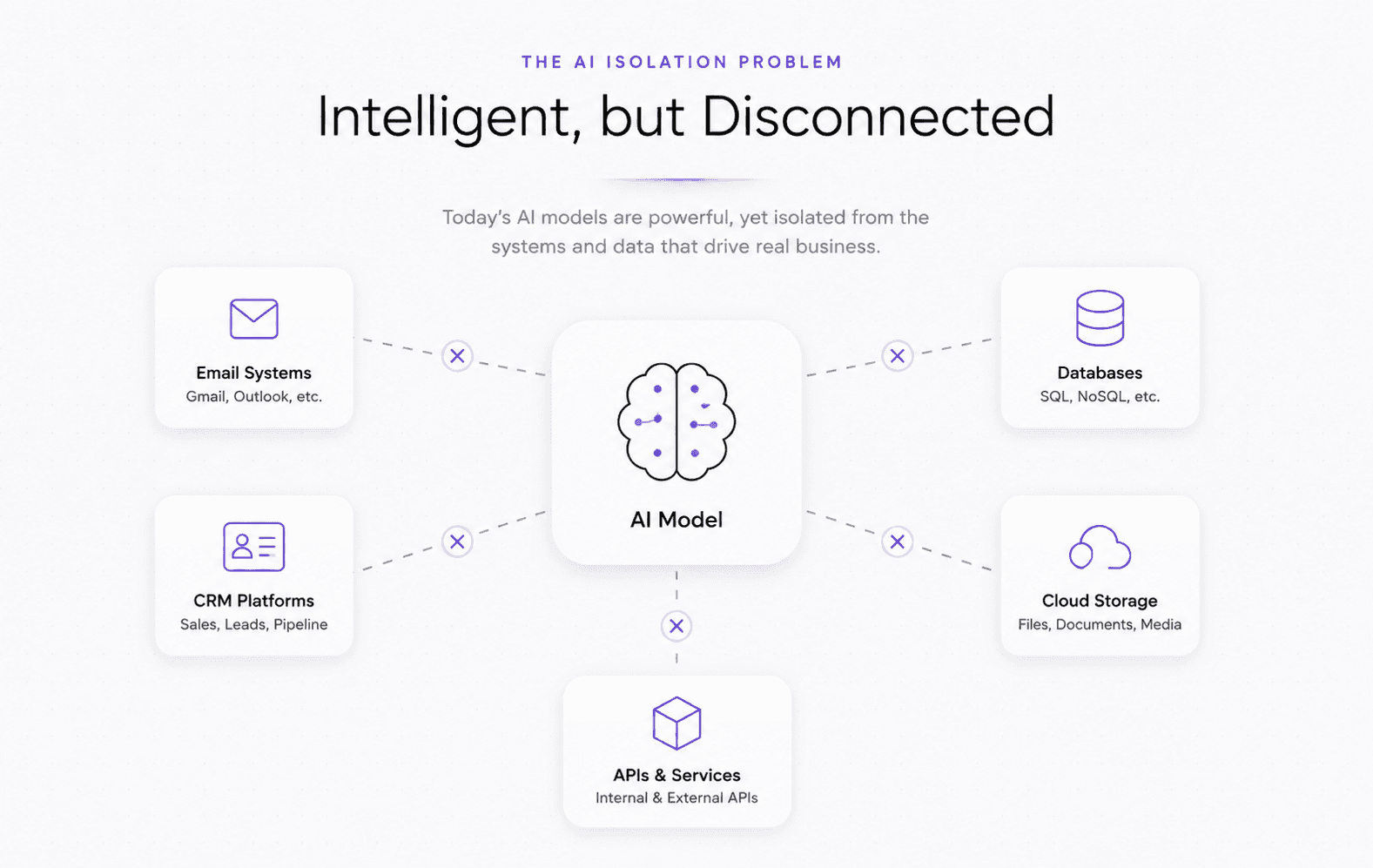
Modern AI systems can reason with astonishing sophistication, yet most remain fundamentally disconnected from the systems where real business operations happen.
Large language models can summarize documents, generate code, analyze patterns, and solve complex reasoning tasks. Their intelligence has improved dramatically.
But intelligence alone does not create operational value. Businesses do not run inside prompts — they run across databases, CRMs, APIs, cloud infrastructure, and internal workflows.
Without access to those systems, AI remains mostly conversational: impressive in dialogue, but limited in execution.
The gap between reasoning and execution is where modern AI systems hit their biggest limitation.
Core Limitations
• No native access to databases
• No direct interaction with APIs
• No operational system connectivity
• No autonomous task execution
An AI model may understand what needs to be done — but without system access, it cannot actually do it.
Connecting AI to enterprise systems has traditionally required custom engineering for every tool, API, and workflow.
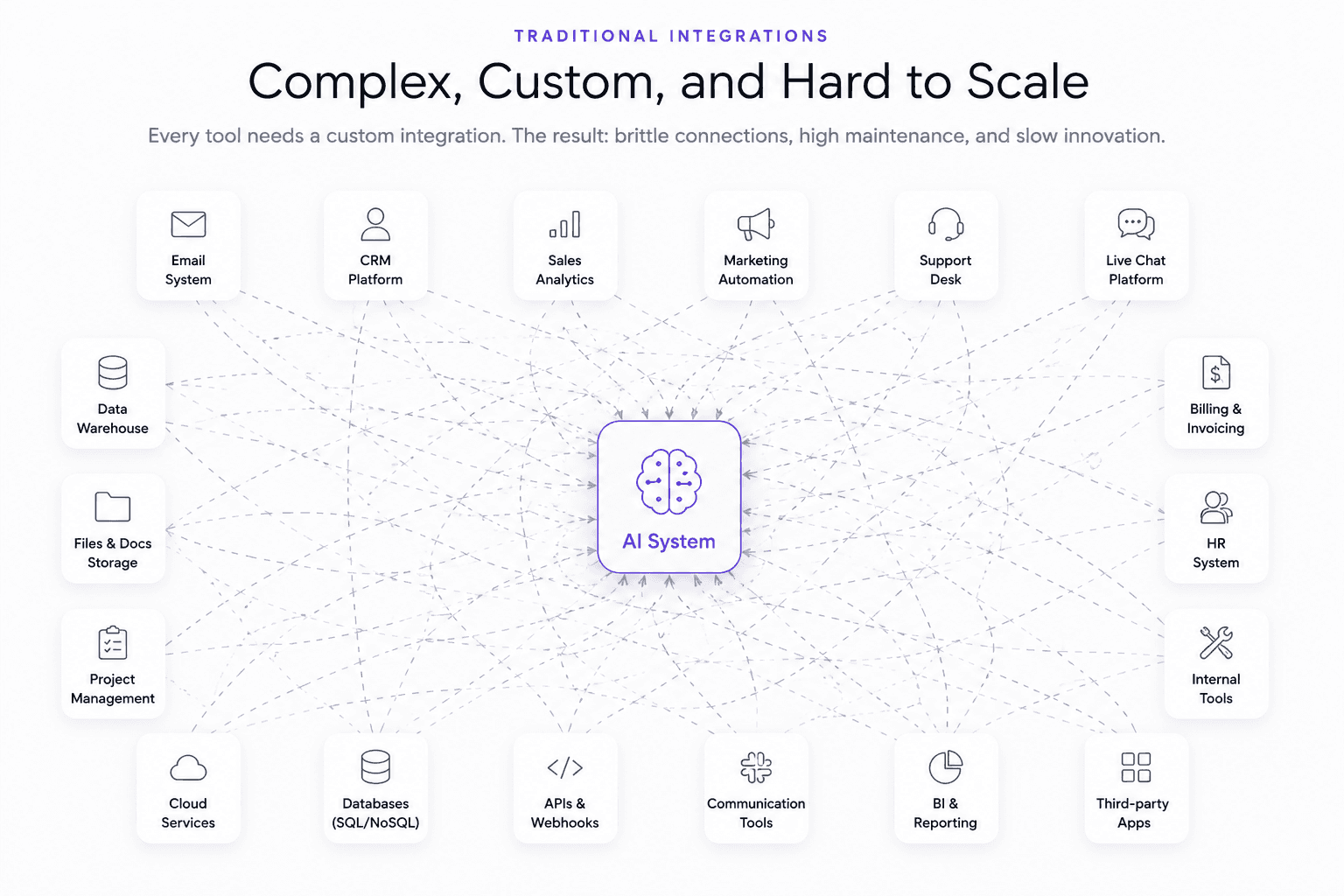
Every enterprise system speaks a different language. Databases, CRMs, communication platforms, internal APIs, and cloud tools all expose different interfaces and authentication models.
Historically, integrating AI with these systems meant building custom connectors for each individual tool. As the number of systems grows, complexity scales rapidly.
These integrations often become fragile, expensive to maintain, and difficult to reuse across products or teams.
Common Problems
• Duplicate engineering effort
• Brittle API dependencies
• High maintenance overhead
• Poor cross-system scalability
As AI adoption grows, bespoke integrations stop being practical.
Model Context Protocol introduces a standardized way for AI systems to communicate with external tools, data sources, and enterprise infrastructure.
MCP, short for Model Context Protocol, is an open protocol designed to solve one of the biggest infrastructure problems in modern AI: fragmented integrations.
Instead of building custom connectors for every AI application and every external system, MCP introduces a shared language that both sides can understand.
This allows AI models to interact with tools and data through a consistent interface, dramatically reducing complexity.
Think Of MCP As
USB-C for AI integrations
One standard connection layer replacing dozens of proprietary integration pathways.
Standardization transforms integration from custom engineering into reusable infrastructure.
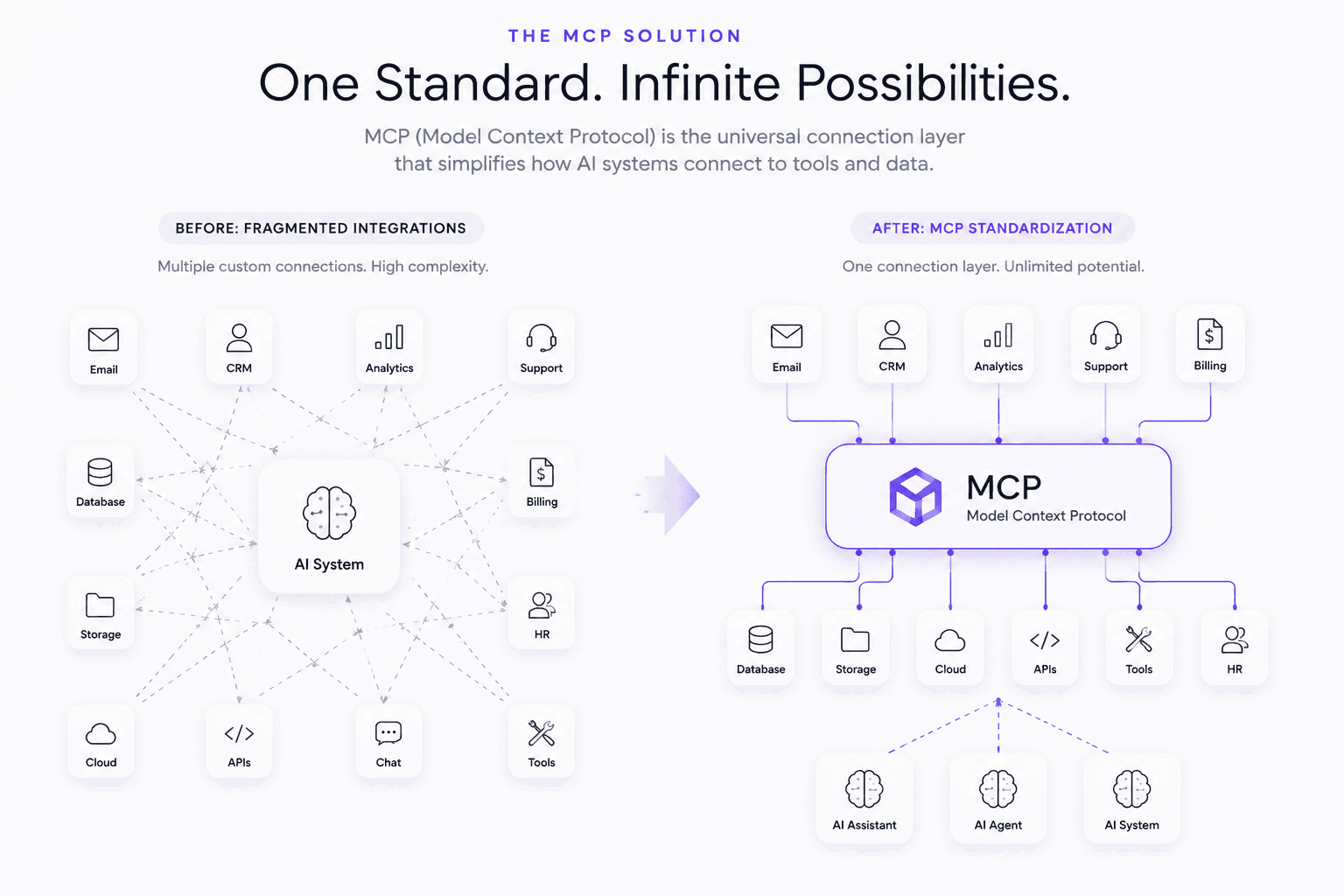
An MCP server acts as the bridge between AI reasoning and real-world execution, exposing capabilities that models can securely access.
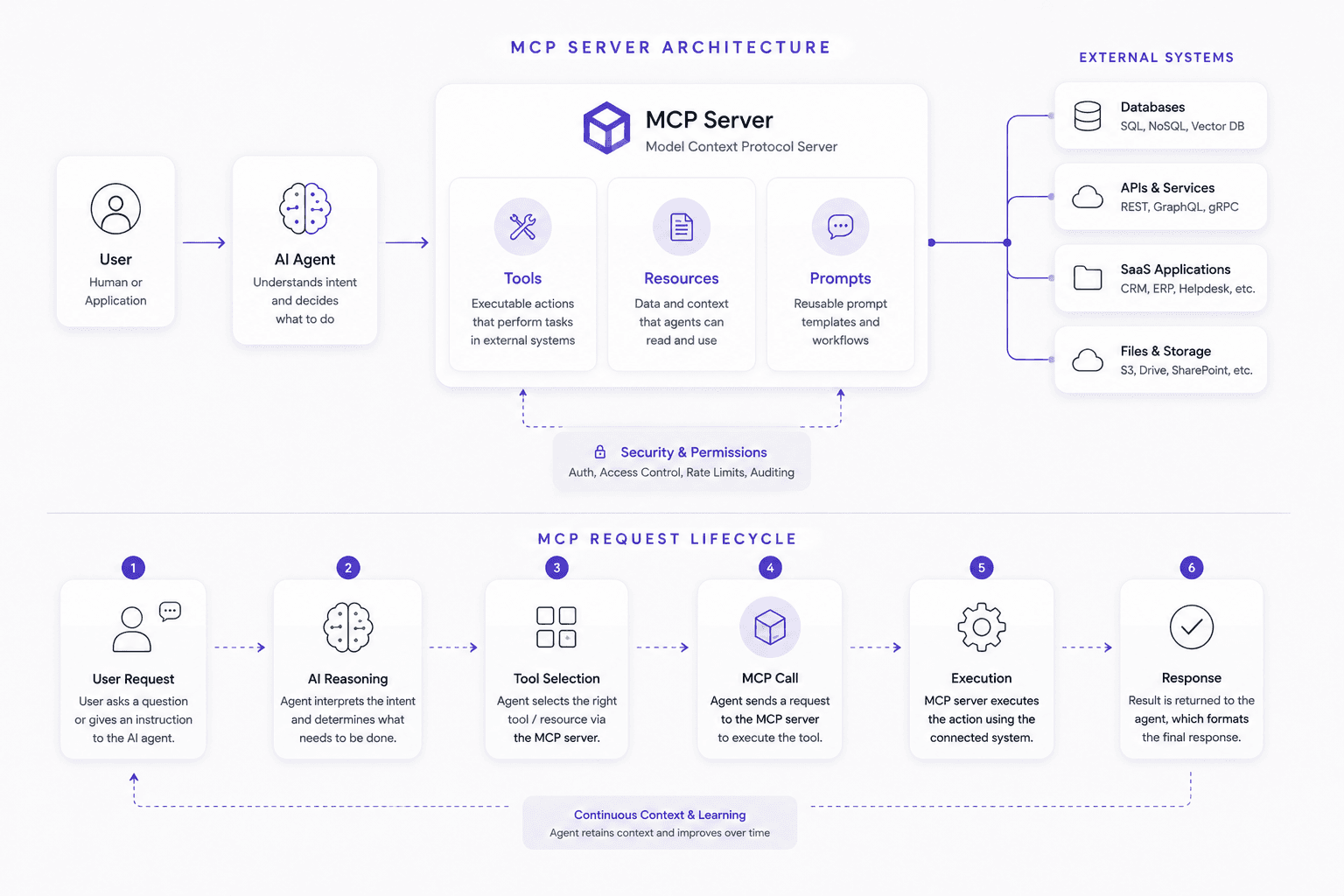
While MCP defines the communication protocol, the MCP server is the component that actually exposes tools, data, and workflows to an AI system.
It acts as an intermediary layer between language models and enterprise infrastructure, translating AI intent into actionable operations.
Instead of allowing direct raw access to internal systems, the server provides a controlled interface with clearly defined capabilities.
Core Components
• Tools — executable actions
• Resources — readable context
• Prompts — reusable workflows
In essence, MCP servers convert intelligence into controlled operational capability.
MCP enables AI systems to move beyond passive reasoning by allowing them to discover, invoke, and execute capabilities in real time.
Every MCP interaction begins with a user request. The AI first interprets the task and determines whether external tools or resources are needed to complete it.
Once the required capability is identified, the AI invokes the appropriate MCP-exposed tool. The MCP server then securely routes that request to the relevant system for execution.
The result is returned to the model, giving it fresh operational context before generating a final response.
Execution Flow
1. User sends request
2. AI reasons about required action
3. Appropriate tool is selected
4. MCP server routes execution
5. External system responds
6. AI returns final answer
The crucial shift is this: AI no longer operates only inside a context window. With MCP, it can interact with the operational systems where real work happens.
MCP is not merely an integration standard. It is foundational infrastructure for the next generation of AI-native businesses.
Customer Support
AI agents that analyze tickets, access CRM data, and resolve issues autonomously.
Sales Operations
Agents that update pipelines, enrich leads, and trigger follow-ups in real time.
Finance
Systems that read reports, reconcile transactions, and monitor operational risk.
DevOps
Agents that inspect logs, detect anomalies, and orchestrate deployments.
As AI systems become increasingly capable, the competitive advantage will no longer come from model intelligence alone.
It will come from infrastructure — the systems that allow AI to reason, access context, collaborate, and execute across entire organizations.
MCP servers may ultimately become the missing infrastructure layer that transforms AI from conversational intelligence into operational intelligence.
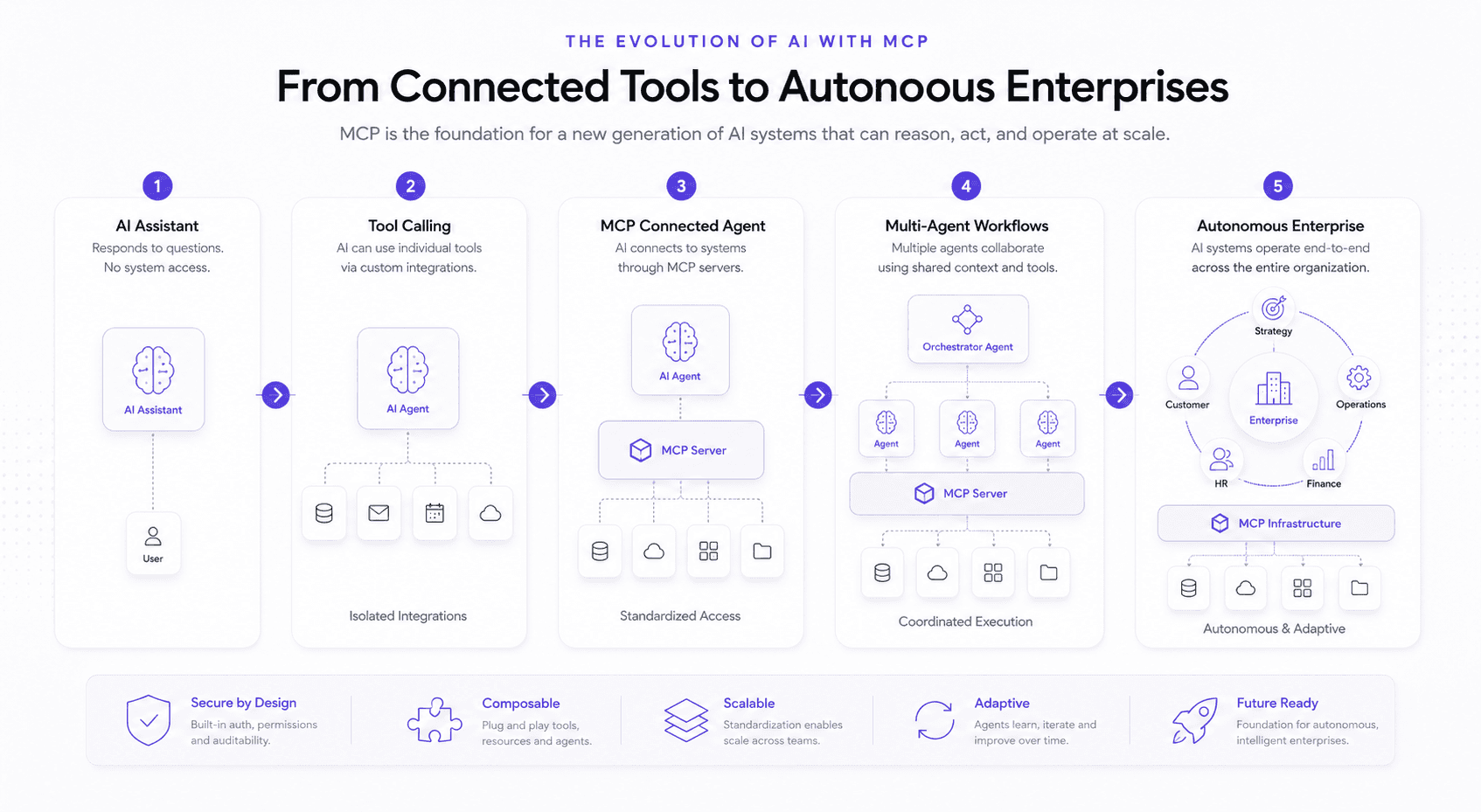
The future of AI is not just smarter models.
It is intelligent systems that can operate in the real world.